B2B Data Provider in India: A Practical Guide to Better Leads and ROI
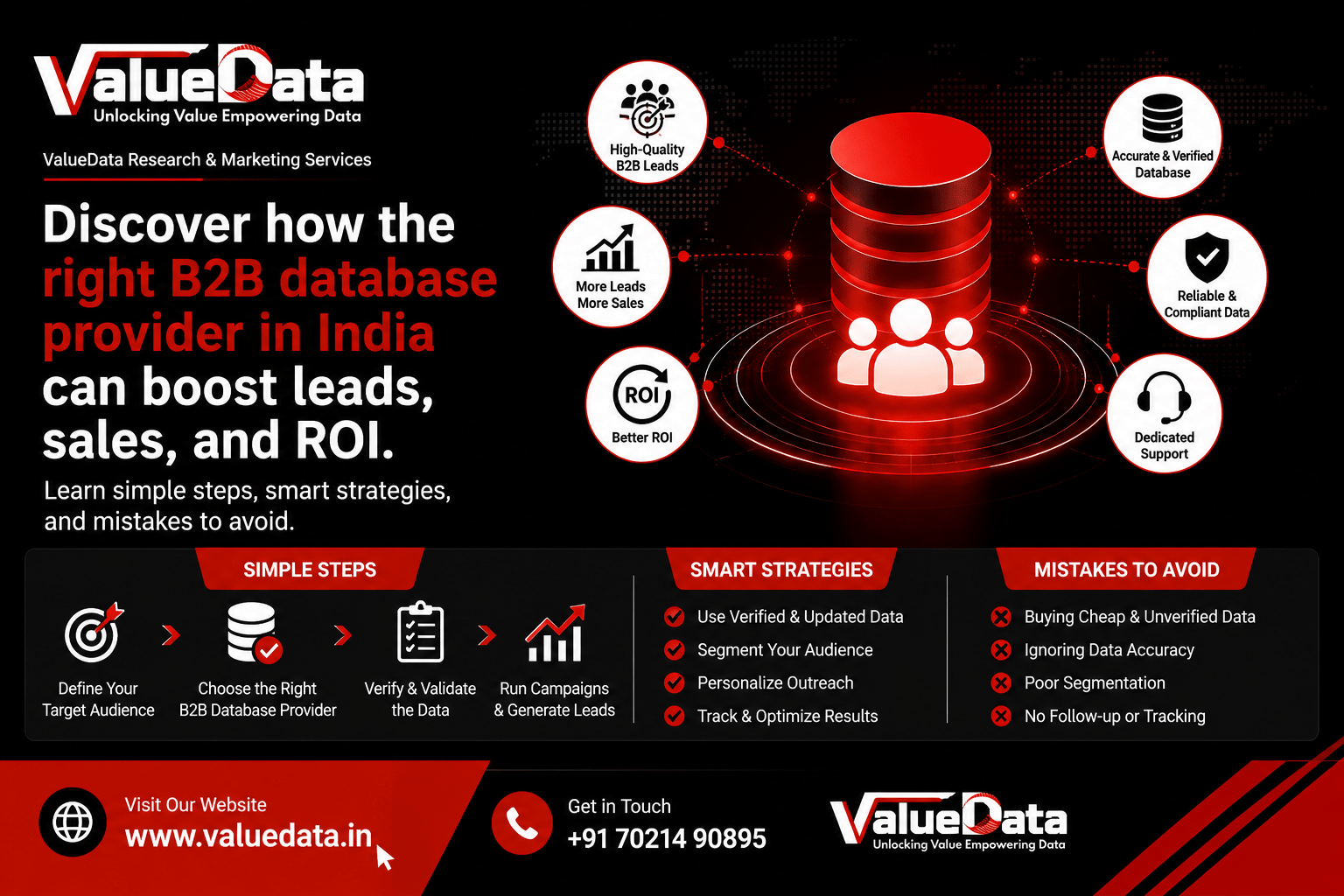
A reliable b2b data provider can enable sales and marketing teams move from broad prospecting towards a more targeted approach based on appropriate business information. Organisations searching for B2B data providers in India typically look for structured information about companies, industries, geographic areas, employee numbers, revenue segments and key decision-makers. When this information is carefully researched, validated and maintained, teams can identify appropriate prospects sooner and dedicate more time to meaningful sales conversations. Choosing a reliable provider is therefore not merely a matter of purchasing a large volume of records. Businesses should assess data accuracy, segmentation, verification methods, update frequency and the capacity to develop customised datasets that match their ideal customer profile.
What Is the Role of a B2B Data Provider?
A b2b data provider gathers, structures, validates and maintains business information that can support prospecting, market research and campaign planning. Rather than asking sales representatives to investigate each company separately, a structured database can provide important details in an accessible format. Depending on specific needs, records may be filtered according to industry, geography, company size, turnover, department or seniority. A professional b2b contact database provider should also pay attention to the freshness of decision-maker information because employees regularly change companies, duties and positions. Routine verification helps reduce wasted effort and makes the information more practical for ongoing sales activities.
Why Accurate B2B Data Matters
Accurate data has a direct impact on the efficiency of sales and marketing campaigns. An enormous database has reduced usefulness when significant portions of it are irrelevant or outdated. Accurate information allows teams to prioritise businesses that closely match their target market. It can also assist with sales territory planning, account prioritisation, market research and tailored campaign development. A regularly updated B2B database India resource can be especially valuable for companies targeting selected regions, cities, sectors or company categories. Better segmentation means representatives can develop messages around genuine industry requirements rather than delivering the same message to every prospect.
Choosing Between B2B Data Providers in India
Businesses assessing B2B data providers in India should first establish what information they specifically require. A manufacturing supplier may seek procurement managers, operations leaders and plant decision-makers, while a software business may be looking for technology leaders, founders and senior management. After identifying the target profile, assess potential providers according to their data research methods, validation practices and frequency of updates. Asking for a sample dataset is useful because it enables a company to assess whether the available fields, segmentation and accuracy meet practical campaign requirements. The best b2b data providers should emphasise relevance and maintainability instead of treating database size as the only indicator of quality.
Evaluating a B2B Data Providers List
When assessing a b2b data providers list, it is useful to compare services rather than merely looking at the number of available records. Some providers specialise in particular industries, while others provide broad datasets covering multiple sectors and regions. Certain providers may focus primarily on company information, whereas others provide deeper decision-maker research, data enrichment, cleansing or customised database development. A useful list of data providers should therefore be reviewed against the organisation's particular goals. The right choice for a large-scale nationwide campaign may be distinct from the right choice for a company targeting a specialised industry within a limited geographical area.
Applying B2B Data to Lead Generation
Once suitable data has been obtained, businesses require a clear process for applying it productively. Records can be segmented according to industry, organisation size, geographic area and decision-maker function. Sales teams can then prioritise prospects that strongly align with their ideal customer profile. Marketing teams can use the same segmentation to produce more relevant campaigns and educational content. A quality B2B contact database provider can therefore support several departments rather than acting solely as a source of initial prospects. Maintaining uniform information across sales systems also helps teams track interactions, remove duplicates and understand which market segments generate better opportunities.
Advantages of a Custom B2B Database
Generic datasets can include thousands of records that have minimal value to a particular campaign. Custom databases reduce this problem by filtering information according to precise criteria before delivery. A business may specify companies from selected industries, specific regions, turnover ranges or employee categories. Decision-makers can then be selected according to function and seniority. This approach can improve productivity because representatives spend less time sorting through unsuitable prospects. A customised B2B database India solution can also facilitate expansion into new territories by giving businesses greater insight into potential accounts before investing considerable sales resources.
Managing Bulk Database Requirements in India
Companies planning large-scale campaigns may seek a bulk database provider India to obtain substantial volumes of structured business information. Volume, however, should never replace quality as the primary consideration. Large datasets need careful organisation, deduplication and periodic validation to remain useful. Businesses should establish which fields are actually list of data providers required and avoid purchasing excessive information simply because it is available. A properly organised bulk database containing relevant prospects can provide substantially more practical value than an enormous collection of unsuitable records. Data management processes should also be implemented internally so that records remain properly managed after they enter sales and marketing systems.
Which Is the Best Data Provider in India?
Businesses asking Which is the best data provider in India? should recognise that the answer varies according to their campaign requirements, target audience and expected level of customisation. Rather than selecting a provider based solely on claims of database size, evaluate data verification, research depth, filtering options, update procedures and responsiveness to specialised requirements. Providers that can demonstrate how records are researched and maintained give businesses greater visibility into data quality. Sample testing is another valuable step because businesses can evaluate whether information matches their target market before making a more substantial investment. The strongest provider is ultimately the one whose data consistently supports relevant prospecting and measurable business outcomes.
Which Are the Top 5 B2B Companies in India?
The question Which are the top 5 B2B companies in India? can have multiple answers depending on whether the comparison relates to data services, technology platforms, marketplaces or other business categories. For database requirements specifically, organisations should look beyond general rankings. A provider that works effectively for one sector may not have the targeted information required by another. Comparing several providers through sample datasets, available filters, custom research capabilities and ongoing maintenance can result in a more meaningful shortlist. Businesses should give preference to measurable suitability for their own sales process rather than choosing solely because a company appears prominently in a general ranking.
Enhancing ROI Through Effective Data Management
Obtaining high-quality data is only the beginning. Businesses must manage it carefully to preserve its value. Duplicate records should be cleared, outdated details should be checked and campaign results should be used to improve future segmentation. Sales teams can discover which industries, company sizes and decision-maker categories generate the best opportunities. Marketing teams can then leverage these insights to improve targeting. Over time, this creates a cycle in which reliable information contributes to more effective campaigns, while campaign results generate further insights for future decisions. A capable b2b data provider can form an important part of this process by providing structured information that facilitates measurable prospecting activity.
Conclusion
Choosing among B2B data providers in India requires more than comparing the number of records available. Businesses should prioritise accuracy, relevance, segmentation, verification, customisation and regular maintenance. Whether an organisation requires a focused B2B contact database provider, a specialised B2B database India resource or a bulk database provider india, the objective should stay consistent: give sales and marketing teams practical business data that helps them identify appropriate prospects efficiently. By establishing an ideal customer profile, evaluating data quality and maintaining records properly, businesses can improve productivity, strengthen campaign targeting and achieve better returns from their lead generation activities.